Moving Image
From 1986 onwards, Breda Beban developed an internationally acclaimed moving-image practice. During the intense twelve-year collaboration with Hrvoje Horvatić (1985–1997), they produced poetic, allegorical single-channel and multi-screen video installations, as well as numerous TV documentaries on the contemporary art scene in the former Yugoslavia (1989–1991). After Horvatić’s premature death in 1997, Beban continued to produce an extraordinary body of work exhibited at major museums and galleries worldwide. In recognition of her work in the UK, she received a Paul Hamlyn Foundation Award for visual artists in 2001.

Works 1985-1997
Breda Beban&Hrvoje Horvatić – video/film/installation/performance:
1985
- Plan, 1985, documented performance, 7 min, colour, mono sound, U-matic, VHS, production Film Val-Beban&Horvatić
- Making a performance, 1985, 20 min, VHS, colour, production Film Val-Beban&Horvatić
- Icons of Invisible Things (original title: Ikone nevidljivih stvari) 1985, 12 min, VHS, colour, production Film Val-Beban&Horvatić
1986
- Meta, 1986, 16 min, colour, mono sound, U-matic and 16 mm, production Film Val-Beban&Horvatić
- She, Four Things (original title: Četiri njene stvari), 1986, 20 min, colour, mono sound, 1” and 16 mm, production TV Beograd-Beban&Horvatić
- Bless My Hands (original title: Pomiluj moje ruke), 1986, 11 min, colour, mono sound, V8 and U-matic, production Film Val-Beban&Horvatić, Paolo&Dubravka Cherubini
- A Pray, 1986, 5 min, b/w, stereo sound, 1”, production Film Val-Beban&Horvatić
1987
- All Our Secrets are Contained in an Image (original title: Sve naše tajne nastaju iz jedne slike), 1987, 10 min, colour/b&w, mono sound, 1” and 16 mm, production TV Skopje-Beban&Horvatić
- Cherishing the Heart (original title: O čuvanju srca), 1987, 8 min, b/w, mono sound, 1”, production TV Sarajevo-Beban&Horvatić
- Taking on a Name, (original title: Primanje imena) 1987, 25 min, colour, mono sound, U-matic, High B, production TV Skopje
1988
- Terirem, 1988, 13 min, colour, mono sound, U-matic, High B, production Film Val-Beban&Horvatić
- For You in Me and Me in Them to be One, (original title: Ja u njima ti u meni da budu samo jedno), 1988, 30 min, colour/b&w, mono sound, U-matic, High B and, 1”, production TV Beograd-Beban&Horvatić
1989
- House, 1989, video installation, Prostor proširenih medija, Zagreb, production Alternative ASKC, Beograd
- Geography, 1989, 9 min, colour, mono sound, Betacam SP, production Video Colony Ohrid, TV Skopje, Beban&Horvatić
1990
- Geography, 1990, video installation Zagrebački salon, Galerija Karas, Zagreb
1991
- Geography 2 (Life is Very Precious Even Right Now), 1991, video installation, production Videopositive, Tate Gallery, Liverpool
- Head in Hands, videotape and film 1991, production Banff Centre, Canada, Studio 5, Zagreb, Beban&Horvatić, photo by Boris Cvjetanović, camera by Sven Pepeonik
- For Tara, 1991, 4 min, colour, stereo sound, Betacam SP, production Studio 5, Zagreb, Momentum, London, Beban&Horvatić
1992
- The Lifeline Letter, 1992, 1 min, colour, stereo sound, Betacam SP, production Beban&Horvatić-Frontline TVS, London
- The Left Hand Should Know, 1992, 43 min, colour, stereo sound, Betacam SP 35mm, production Beban&Horvatić, Frontline TVS, London
- The Shape of Pain, 1992, video installation, The Art Gallery of New South Wales, Sydney; 1994, Impakt, Ekko House, Utrecht
1993
- Before the Kiss, 1993, video installation, Prema Arts Centre, Uley, Glos
1994
- Absence, She Said, 1994, 15 min, Betacam SP 35 mm, colour/b&w, production Beban&Horvatić-Frontline TVS, London
1995
- Irina is Not Herself Anymore (working title: Going out, Getting in), 1995, 4 min, 35 mm, colour, production: Production Fund Carlton TV, London, Beban&Horvatić
1997
- Hand on the Shoulder, 1997, film, 43 min, Betacam SP, b/w, production Beban&Horvatić
- Jason’s Dream, 1997, short film/musical, 10 min, 16 mm, colour, production Beban&Horvatić, London Production Fund, Carlton TV; film/musical completed by Breda Beban in 1998
Works for Television
In 1989-1991 Breda Beban and Hrvoje Horvatić produced and directed “TV exhibitions”, a documentary TV series on contemporary visual artists and series of ten short programmes.
Selected:
1989
- Few Dear Names, 1989, 35 min, Betacam SP, 1”, colour, b/w, TV Skopje, featurette based on poetry by Wystan H. Oden, shot in various locations in Macedonia
1990
- Video Art and Money, 1990, 60 min, Betacam SP, colour, TV Zagreb, documentary on video art directors and producers, shot in locations in London
- Take Me to the Water, 1990, 17 min, Betacam SP, colour, TV Zagreb, documentary on a social/political photographer Boris Cvjetanović
- For Goranka Matić, 1990, 14 min, Betacam SP, sound, TV Zagreb, homage film, featuring works by one of the best female photographers in ex-Yugoslavia
- Jermanogrammes, 1990, 16 min, Betacam SP, colour, TV Zagreb, documentary on artist Željko Jerman
1991
- Pain is There Is no Art Without Consequences, 1991, 18 min, Betacam SP, colour, TV Zagreb, documentary on conceptual artist Mladen Stilinović
- Faces and Portraits, 1991, 17 min, Betacam, SP, colour, TV Zagreb, documentary on photographer/conceptual artist Milisav Mijo Vesović
- Shadows and Presence, 1991, 40 min, Betacam SP, colour, documentary on seven contemporary artists from Canada, shot on locations in the Rocky Mountains, Banff and Calgary
Bless My Hands
Original title: Pomiluj moje ruke
1986
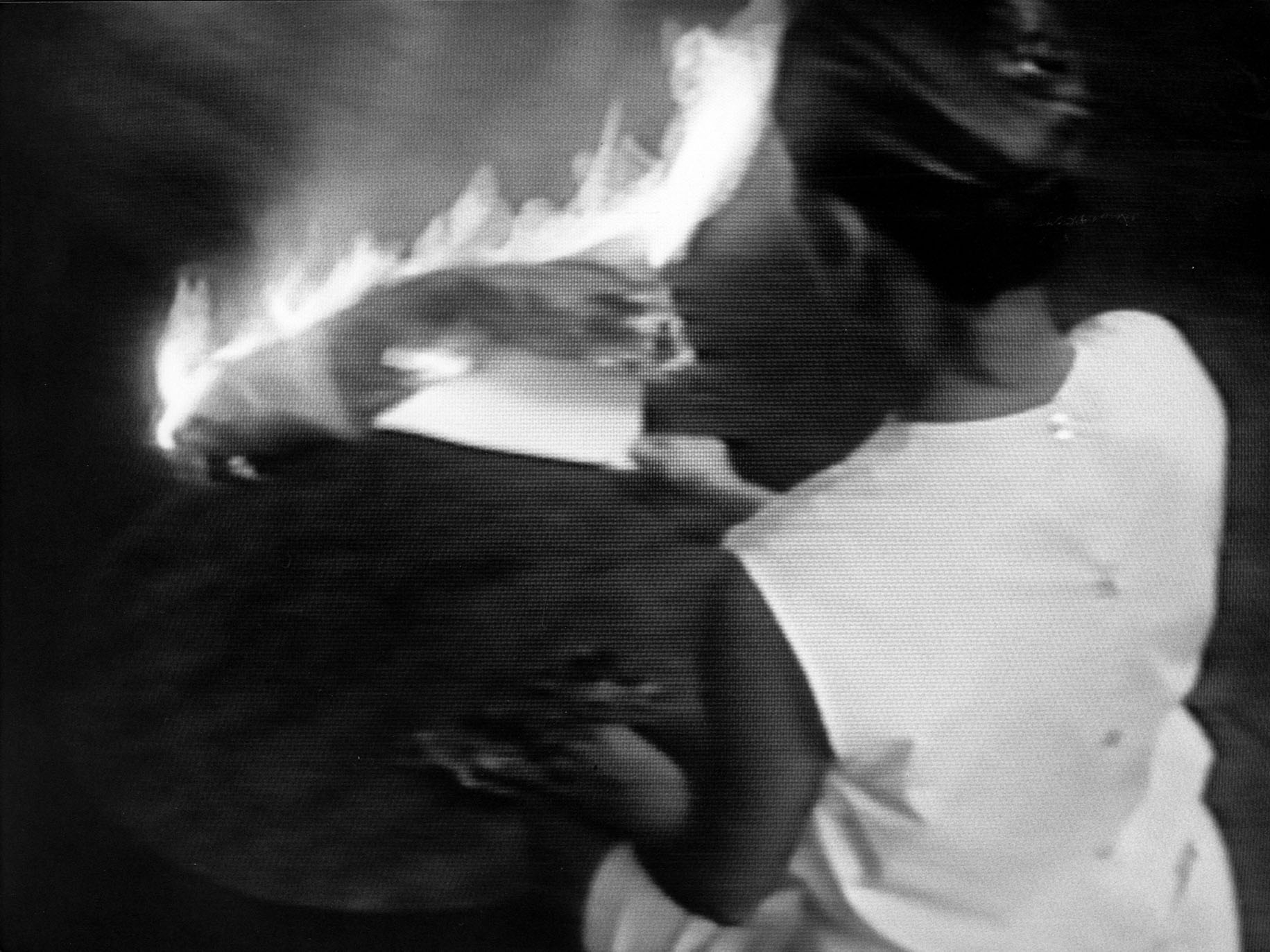
Narrated in the form of a personal prayer, Bless My Hands is Beban’s and Horvatić’s response to a certain questions debated on the art scene of Zagreb in the early 80s.
The video piece possesses a meditative quality, filmed using a fixed camera; the artist kneels before a tray and, as she burns paper, recites: “Bless my hands, grant that I may be good, grant that I may be loved.”
- Direction
- Breda Beban&Hrvoje Horvatić
- Script
- Breda Beban
- Duration
- 11 min
- Photography
- Sven Pepeonik, Peter Bratuša
- Performer
- Breda Beban
- Original format
- V8 and U-Matic, colour, mono sound
- Filmed in
- Multimedia Space, Zagreb
- Production
- Film Val and Beban&Horvatić
- Funded by
- Beban&Horvatić, Paolo&Dubravka Cherubini
Meta
1986
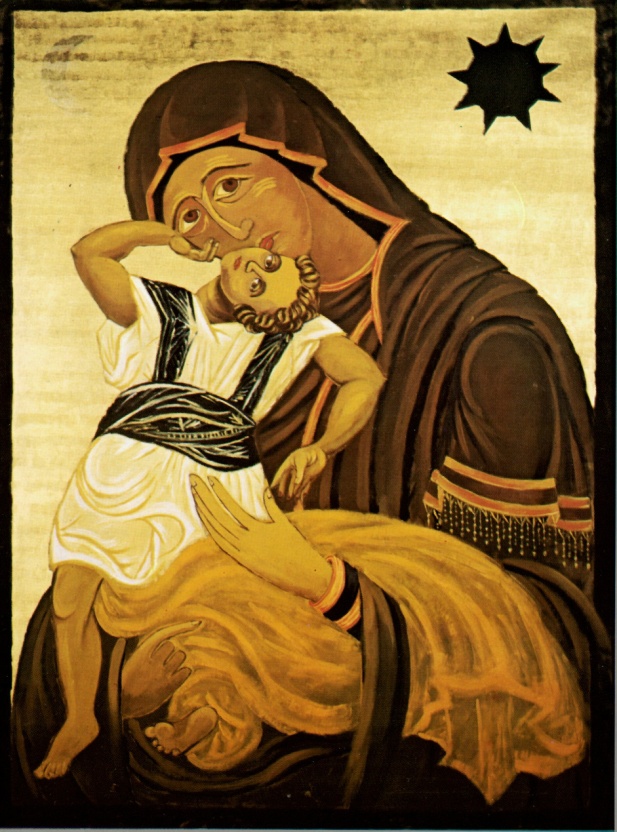
Meta is a video performance marking the inaugural collaborative project produced independently by Breda Beban&Hrvoje Horvatić.
The work draws its primary inspiration from medieval Byzantine art within former Yugoslavia, which Beban&Horvatić identify as their sole authentic artistic heritage. At its core, the piece examines love as a fundamental spiritual category defined by the tension between female and male principles. Ultimately, Meta serves as an exploration of the inherent instability of love.
- Direction
- Breda Beban&Hrvoje Horvatić
- Script
- Breda Beban
- Duration
- 16 min
- Photography
- Sven Pepeonik
- Editing
- Beban&Horvatić
- Music
- Arco part
- Cast
- Breda Beban and Tomislav Martić
- Filmed in
- Zagreb
- Production format
- U-matic hi.band, 16mm, colour
- Funded by
- Beban&Horvatić
She, Four Things
Original title: Četiri njene stvari
1986
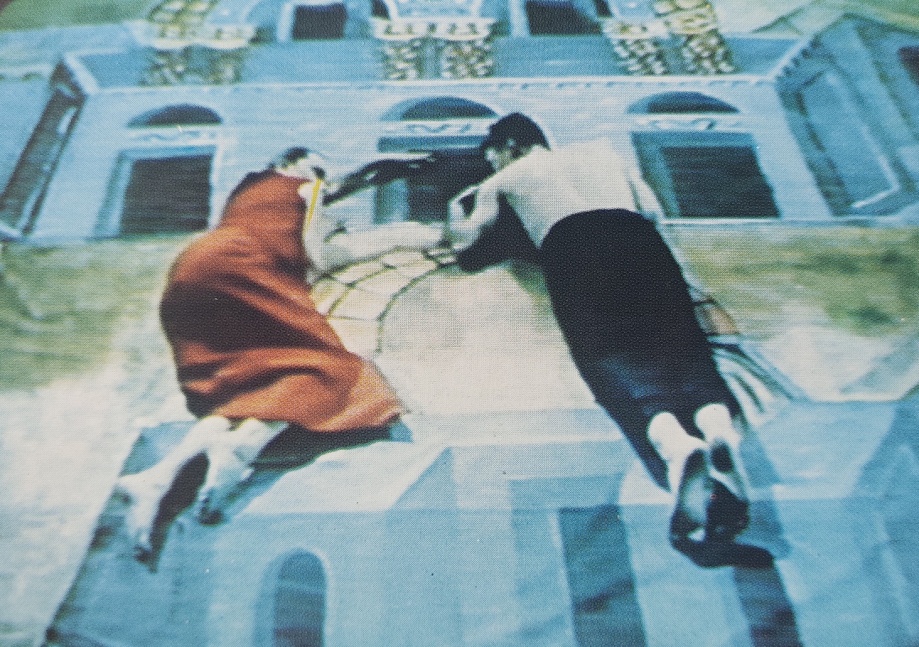
Breda Beban incorporates her painting into a performance-based context in which the video introduces a more complex temporal dimension, unlike traditional gallery performances staged in front of her paintings. She employs her own private visual language, while drawing upon familiar cultural symbols from Byzantine art as well as alchemical symbols of water and fire. The entire video image is rigorously controlled — as in the painting — with each element in the frame carrying its own symbolic value. The action is executed in the tradition of gestural dance.
- Direction
- Breda Beban&Hrvoje Horvatić
- Duration
- 20 min, colour mono sound
- Film camera
- Sven Pepeonik
- Camera
- Dmitar C.
- Production Design
- Breda Beban
- Editing
- Radomir Todorović
- Format
- 16 mm, 1 Inch
- Location
- TV Beograd Studios and in Zagreb
- Produced by
- Dunja Blažević
All Our Secrets Are Contained in an Image
Original title: Sve naše tajne nastaju iz jedne slike
1987
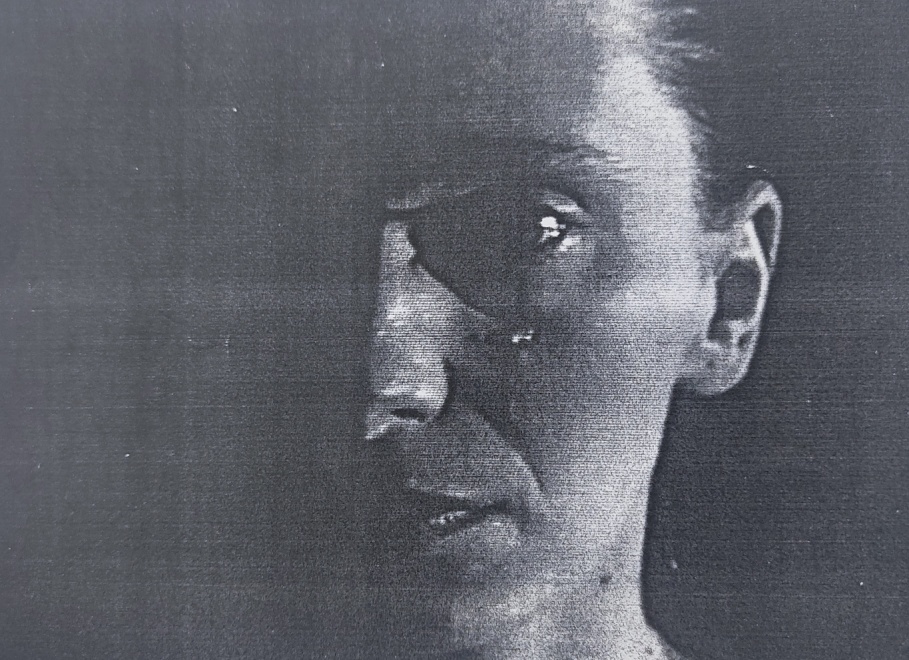
There exist moments in life when sudden, transformative changes propel us through a metaphorical sheet of glass. In these instances, we confront fear and pain, only to find ourselves already on the other side. It is the most sensitive skin that retains the deepest traces.
The work constitutes a ritual of capturing this sensation upon the artist’s return to Skopje, which was devastated by the catastrophic earthquake of 1963 — an event that abruptly interrupted her childhood.
- Duration
- 10 min, VR, colour, sound
- Production
- TV Skopje
Taking on a Name
Original title: Primanje imena
1987
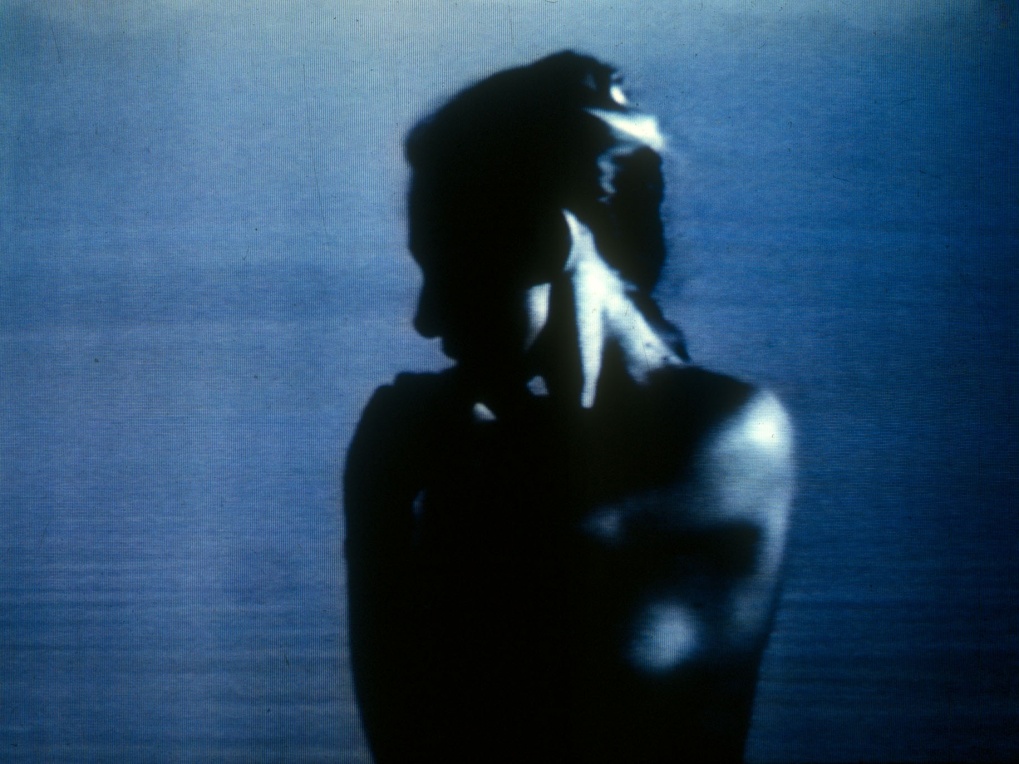
Drawing on the allegory of Plato’s cave, Taking on a Name is a self-portrait in the landscape. The film focuses on the artist’s relationship with her beloved Lake Ohrid. Standing almost at water level, with the horizon and mountains appearing indistinctly above the ground, the artist’s figure oscillates between a state of acute separation from her surroundings and a disintegration into shadow. This effect is achieved purely through a delicate balance between film light and the natural light that rises at dawn and disappears at dusk.
Taking on a Name was filmed near a cave whose ground was covered with water and whose walls were painted with Byzantine frescoes. This cave had been her favourite place since childhood.
- Direction and script
- Breda Beban&Hrvoje Horvatić
- Duration
- 25 min
- Photography
- Dime Pejovski
- Editing
- Ljupčo Argirovski
- Musica
- Beban&Horvatić
- Performer
- Breda Beban
- Filmed at
- Lake Ohrid
- Funded by
- TV Skopje
- Original format
- U-matic hi-band, colour
- Production
- Katica Trajkovska
For You and Me and Me in You to Be One
Original title: Ja u njima ti u meni da budu samo jedno
1988
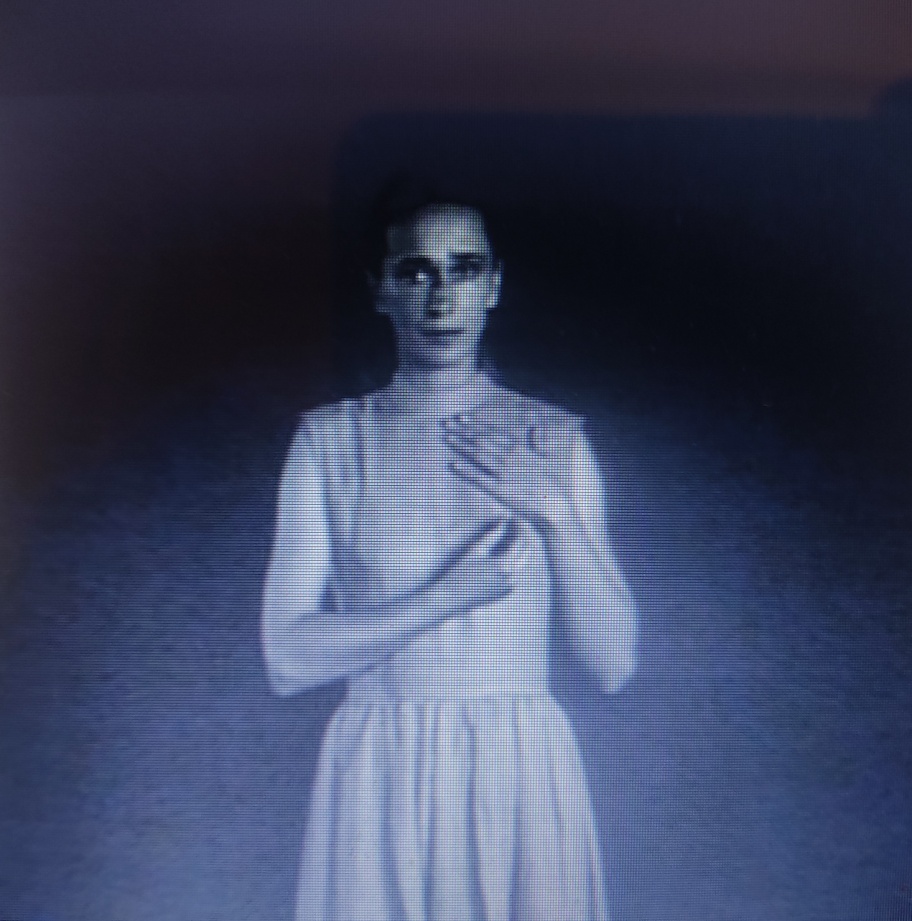
Filmed in the mountains of southern Serbia, this work is simultaneously a cinematic exploration of painting techniques based on Pavel Aleksandrovič Florenskij‘s theory of the Icon and a love letter to the genius loci of the S. Monastery, which served as the author’s artistic sanctuary during the 1980s. The film explicitly references Sergej Iosifovič Paradžanov’s The Colour of Pomegranates.
The epic poetry of Breda Beban finds a tangible home within this landscape, which is imbued with privileged moments accessible only to those who open themselves to their mystery.
- Production
- Breda Beban&Hrvoje Horvatić, TV Beograd
- Direction & Script
- Beban&Horvatić
- Duration
- 43’
- Photography
- Miloš Mitrović
- Editing
- Radomir Todorović
- Direct sound
- Milan Stojanović, Andrija Novaković
- Sound post-production
- Bojan Kondres, Ante Jergović
- Cast
- Breda Beban, Radica Despotović, Sister Teodora
- Filmed in
- Monasteries in Sopoćani, Đurđevi stupovi, Crna Reka
- Original format
- U-matic, High B&1, col. & b/w
- Production format
- Beta SP, DVD
Geography
1989
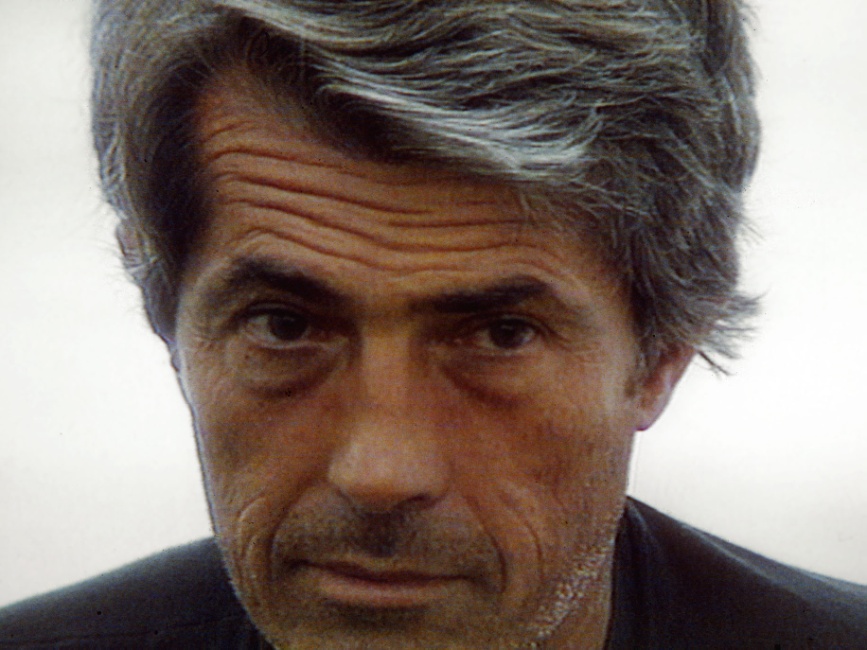
Reaffirming Carl Theodor Dreyer’s assertion that “the human face is the most beautiful landscape”, Geography focuses on the face of a non-professional actor as an unwritten terrain that, during filming, can abruptly turn inward or transform into something entirely distinct. Shot in the summer of 1988, the film is imbued with a palpable foreboding of the tragic events that were to accompany the dissolution of Yugoslavia. Indeed, the geography invoked in the title pertains as much to the contemplative shifting of contours upon the landscape of the face as it does to the sanguinary cartography of the impending civil war in the region.
- Production, Direction, Script
- Breda Beban&Hrvoje Horvatić
- Duration
- 9 min
- Photography
- Dimitar Vladički
- Editing
- Breda Breda Beban&Hrvoje Horvatić
- Sound project
- Breda Beban&Hrvoje Horvatić
- Music
- Tambuco by Carlos Chavez
- Interpreter
- Boško, their driver in Macedonia
- Filmed in
- the summer of 1988 on Lake Ohrid and on mountain Galičica, Macedonia
- Production format
- Beta SP, colour, mono sound
For Tara
1991
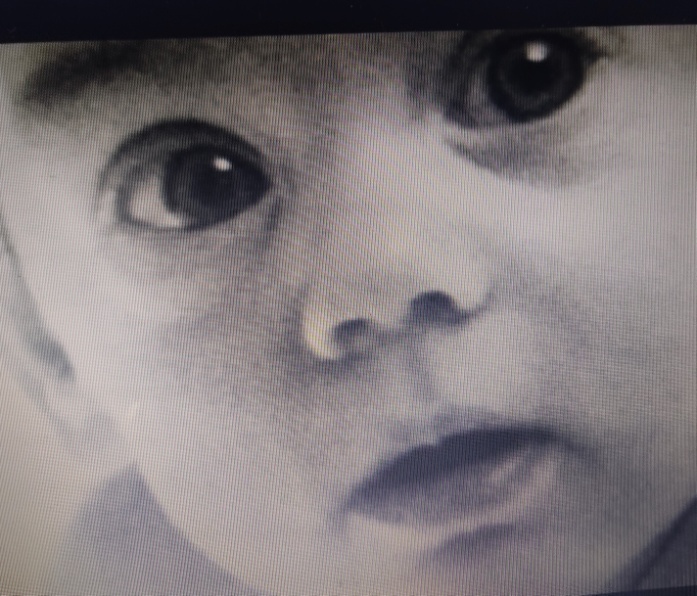
This visual work serves as an affirmation of life set against the backdrop of devastation wrought by the civil war in the former Yugoslavia. Rather than directing the lens toward the immediate realities of conflict, the creators employ a series of evocative, abstract imagery that culminates in an apotheosis: the depiction of an infant, serving as a universal motif for vulnerability and renewal. Executed in the manner of a poetic composition set to visual music, the video engenders a profound and compelling sense of melancholy.
- Duration
- 4 min
- Format
- Betacam SP, colour, stereo sound
- Filmed in
- Zagreb in 1991 during the bombing of the city
- Production
- Beban&Horvatić, Studio 5, Zagreb, Momentum, London
Absence, She Said
1994
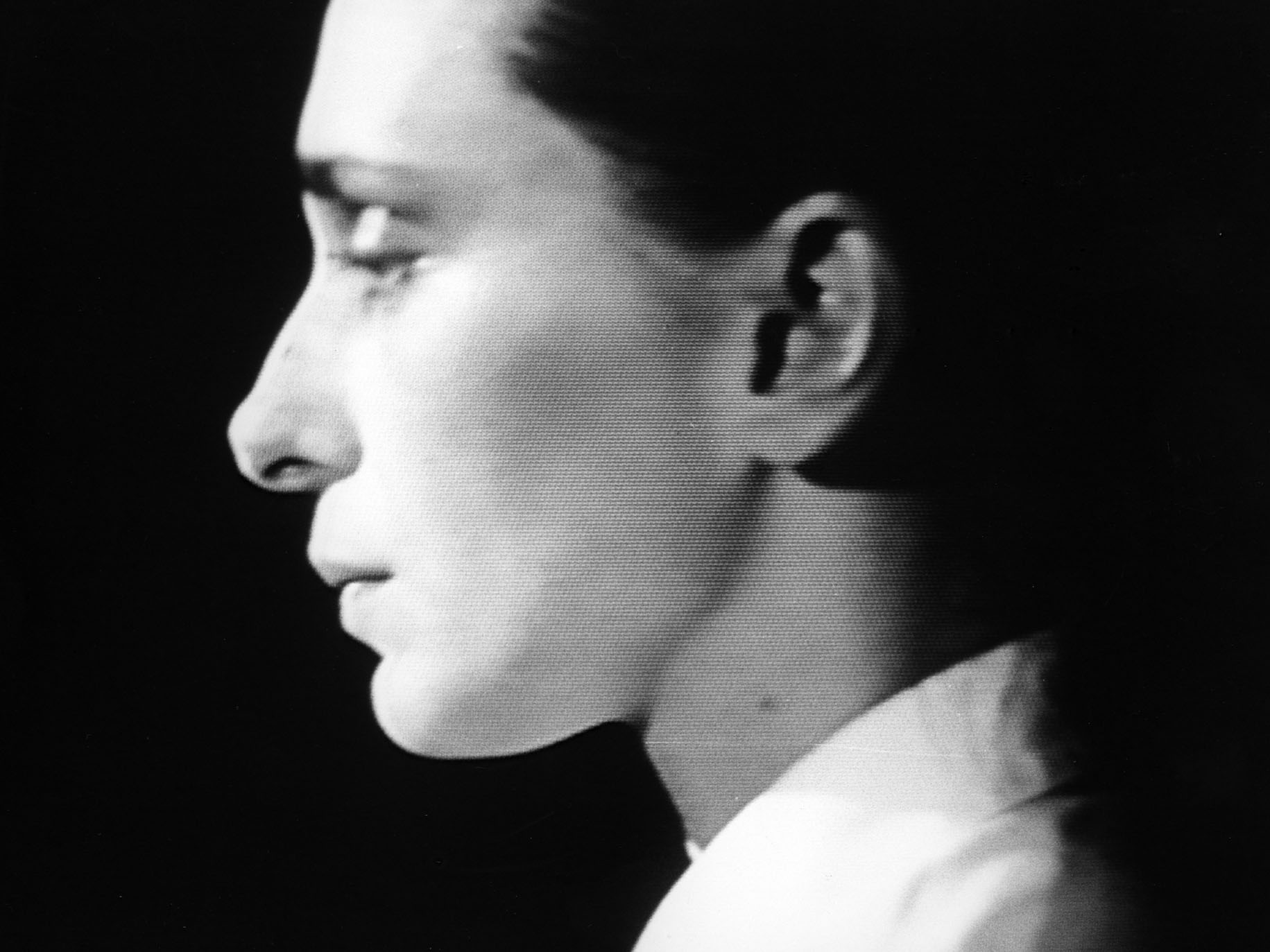
This visual poem explores themes of isolation and belonging, drawing upon subtle rhythmic structures to evoke the poignant anguish of an unbearable loss. The work implies that the unfolding events exist concurrently as visions, memories, and physical occurrences—a tapestry of evocative, subjective imagery perceived through a lens of grief.
- Production, direction and script
- Breda Beban&Hrvoje Horvatić
- Duration
- 16 min
- Photography
- Hrvoje Horvatić&Peter Moseley
- Editing
- Phil Harding
- Music
- Beban&Horvatić, Conor Kelly
- Filmed in
- Stockholm and London
- Original format
- 16mm, Betacam SP, 35 mm, colour, b/w, stereo sound
- Founded by
- Arts Council of England & Ontario Arts Council
Hand on the Shoulder
1997
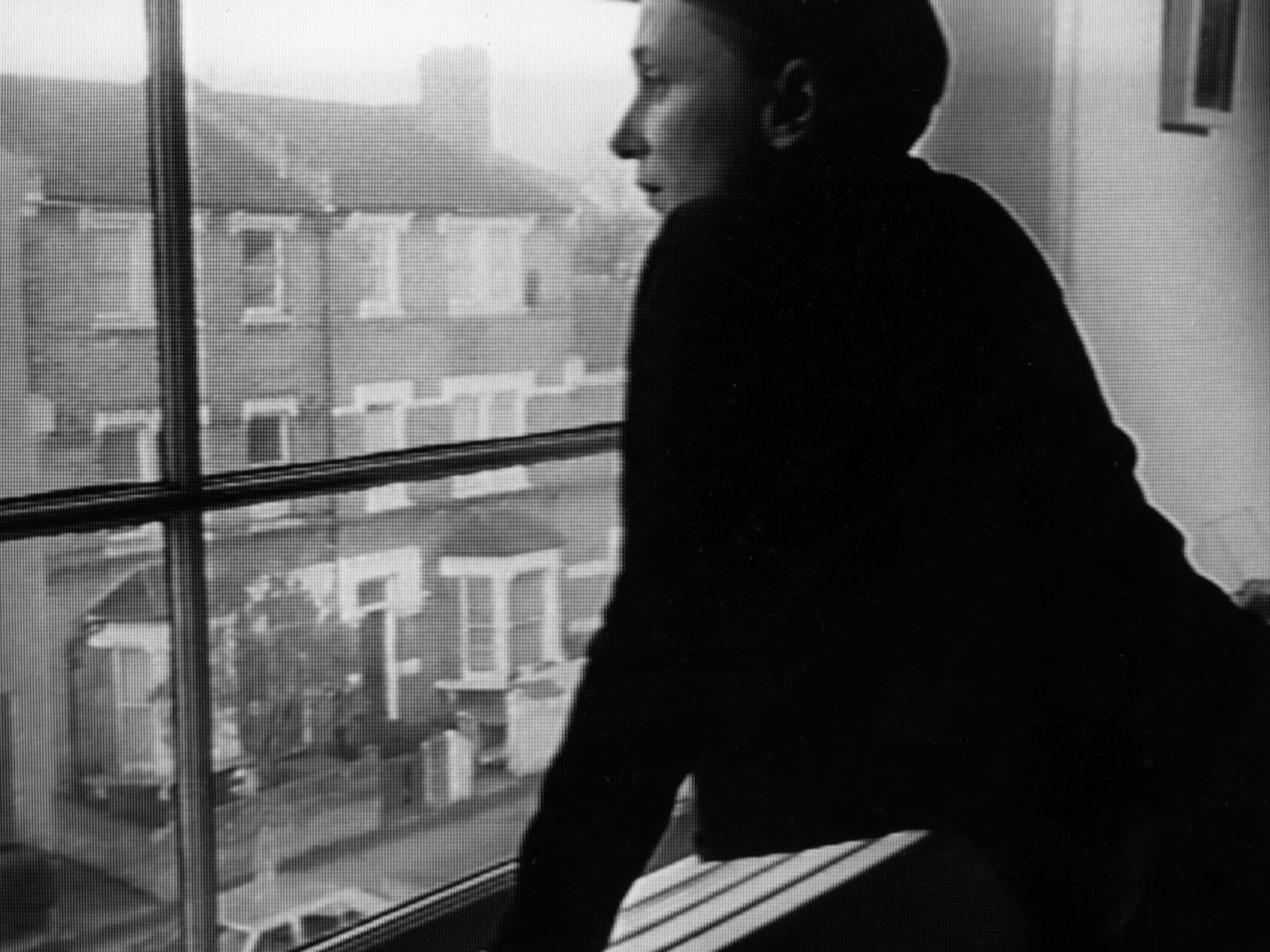
This film constitutes a synthesis of Beban&Horvatić’s engagement with personal psychological trauma within a broader historical context, as well as their distinct approach to cinematic language. The work consolidates many of the defining characteristics of their previous oeuvre, most notably their treatment of objects, lighting and camera techniques, and thematic preoccupation with literary archetypes. On this occasion, however, these elements are deployed to directly interrogate genre, narrative, and character. Serving as a deeply personal project for Hrvoje Horvatić, dedicated to his father, the film is imbued with the poignant retrospection and regret characteristic of exile, while simultaneously representing a significant artistic progression.
- Production, direction and script
- Breda Beban&Hrvoje Horvatić
- Duration
- 42 min
- Photography
- Sven Pepeonik
- Editing
- Angie Short&Steven Murphy
- Cast
- Breda Beban, Dušan Lazarević, Ana Karić, Tomislav Martić
- Voice over
- Frances Barber
- Filmed in
- London and Zagreb
- Original format
- 16mm b/w, sound
- Commissioned and financed by
- Council of England, Channel 4, Ontario Arts Council, Beban&Horvatić
Works 1998-2011
Breda Beban – video/film works:
1998
- May 98, 1998, 10 min, 16 mm, short film/musical, colour, sound, shot in London
1999
- Backstory, 1999, 5 min, S8 mm/DVC, b&W, colour, sound, shot in London
2000
- Still, 2000, 5 min, 16 mm, film on video, colour, camera: Sven Pepeonik, shot in London
- Never Only One X 3, 2000, Psychic Reading Session, 45 min, video, colour, sound, shot in London
- Let’s Call It Love, 2000, 7 min, 30 sec, Super 8, colour, sound
2001
- Too Early for Sorrow Too Late for Happiness, 2001, 45 min, DV-cam, colour, sound, shot in London, Belgrade, Novi Sad
2002
- Little Films to Cry to, series of six films:
- Imagination is Funny, 2002, 5 min, 20 sec, Super 8, DV-cam, colour, sound, shot in London
2003
- Together Again, 2003, 4 min, DV-cam, colour, sound, shot in London
- Angel, 2003, 12 min, 30 sec, Mini DV-cam, colour, sound, shot il London
- One Day in a Far-off Place Somewhere, 2003, 4 min, Mini DV-cam, colour, sound, shot in London
- Monastic Calling, 2003, 5 min, 30 sec, Mini DV-cam, colour, sound, shot in Zagreb
- Love Itself, 2003, 6 min, 30 sec, Mini DV-cam, colour, sound, shot in the Island of Ugljan
- Beautiful Exile 1-5, 2003, 6-15 min, DV-cam, colour, shot in Duino
- I Can’t Make You Love Me, 2003, two 8 min segments looped, DV-cam, colour, shot in London
- Stories I Tell Myself, 2003, 90 min, mini DV-cam, colour, sound, shot in London
2004
- How To Change Your Life In a Day, 2004, 10 min segment loop, DV-cam, colour, sound
2006
- The Most Beautiful Woman in Gucha – part 1, 2006, two segments looped, 8-19 min, colour, sound, mini DV-cam, shot in Guča
2007
- The Most Beautiful Woman in Gucha – part 2, 2007, mini DV-cam, colour, sound, shot in Guča
- Walk of Three Chairs, 2007, 10 min segment looped, DV-cam, colour, sound, shot in Belgrade
2008
- My Funeral Song 1-5, 2008/2010, 5 segments looped, 3-7 min, mini DV-cam, colour, sound, shot in Buenos Aires, London
Jason’s Dream
1997/1998
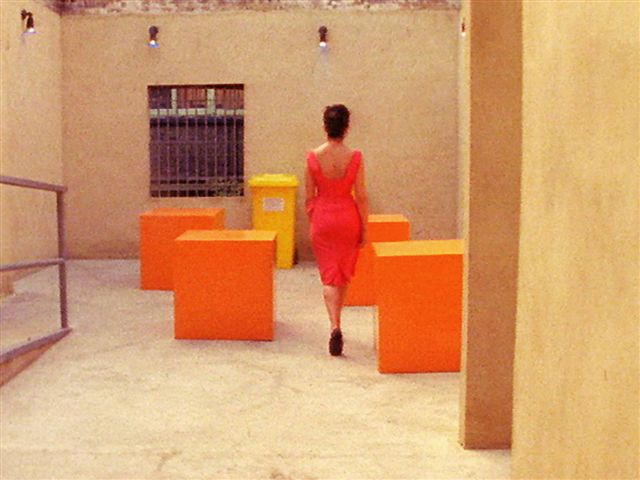
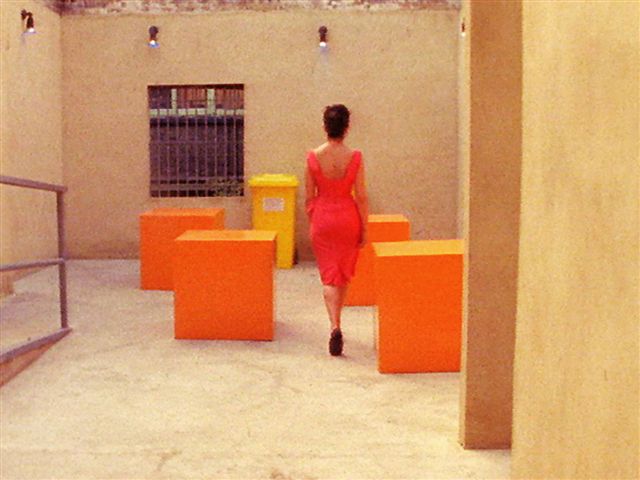
Featuring real-life characters and locations, Jason’s Dream is a musical about a hesitant relationship between two young city-dwellers. The events are narrated from the point of view of a beautiful, song-speech gifted waitress.
Jason’s Dream, with its affectionate atmosphere, vibrant colour scheme and seductive camera movements, has been described as if an East European Jacques Demy with pronounced contemporary sensibilities had been let loose in present-day London.
- Production
- Breda Beban&Hrvoje Horvatić
- Direction and Script
- Breda Beban
- Photography
- Paul Swift
- Editing
- Steven Murphy
- Music
- Beban&Horvatić and Bell Helicopter
- Cast
- Aisha Khan, Jason Martin
- Filmed on locations in London
- Colour
- Duration
- 10 minutes
- Funding
- LFVDA and Carlton Television
- Film was completed by Breda Beban in 1998
May 98
1998
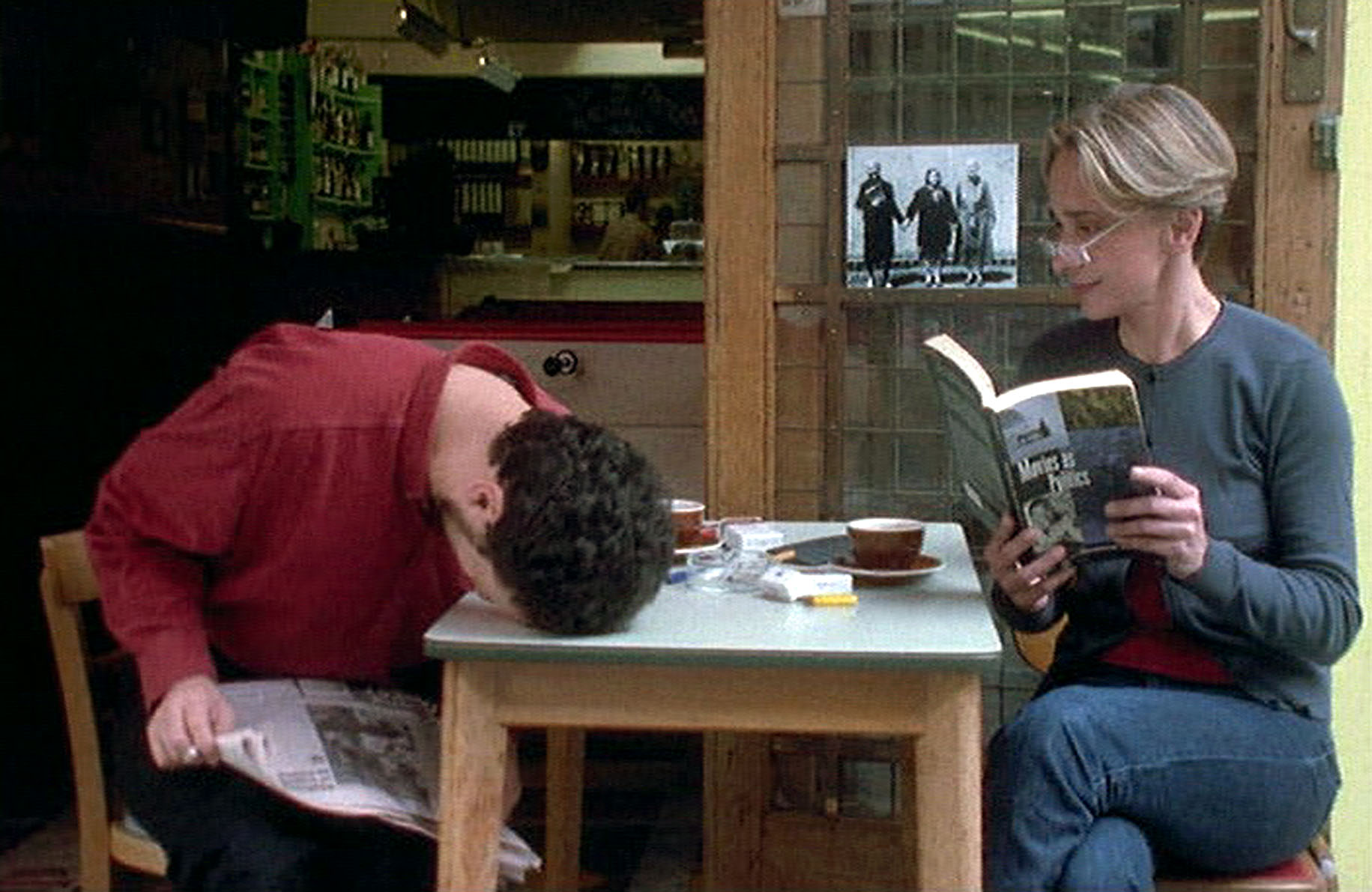
May 98 is a musical shot in London thirty years after the events of May ‘68 and a year after the Labour government came into power. The film’s out-of-joint narrative is held together by Beban’s unfortunate habit of falling down in front of historical buildings that were erected as representations of institutionalised power.
All performers in the film are real-life characters and they play themselves. In production terms, the film was pre-designed for a one shot one take strategy.
- Production
- Breda Beban & Illumination Films
- Direction and Script
- Breda Beban
- Photography
- Sven Pepeonik
- Editing
- Steve Sprung
- Sound
- Ron Wright
- Music
- Peter Astor
- Cast
- Jonathan Romney, Breda Beban, Keith Griffiths, Bojana Žeželj Kovačević, Peter Astor
- Shot on locations in London, thirty years after the events in 1968
- Colour and b&w
- 10 mins, 16 mm, short film/musical
- Commissioned by
- Illumination Films
- Funding
- BBC2
Let’s Call It Love
2000; film for gallery staging
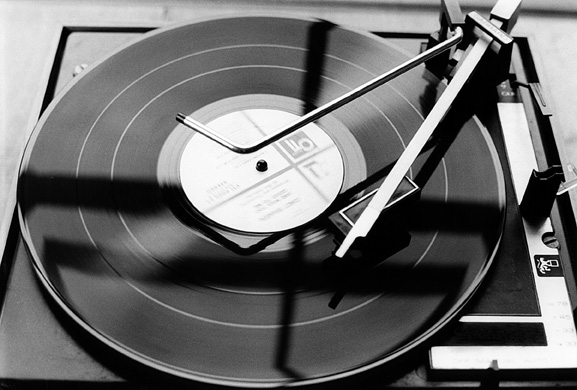
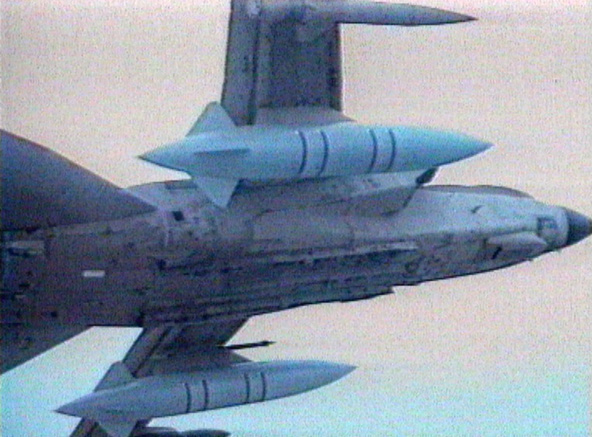
Triggered by the bombardment of Serbia in 1999, Let’s Call it Love features a turntable playing a track by Chet Baker which is intercepted by documentary footage of American warplanes.
Let’s Call it Love is about seduction, longing and loneliness. It is also about an overall sense of helplessness within the context of contemporary world politics.
When Let’s Call it Love is staged in a gallery, sound mix equipment is used to boost low frequencies and thus balance the levels between the love song and the sound of warplanes flying over head. In this way the sound of warplanes flying overhead becomes a physical experience for the viewer.
- Production and Direction
- Breda Beban
- Photography
- Alessandra Scherillo
- Editing
- Steve Sprung
- Sound script
- Breda Beban
- Sound
- Ron Wright
- Music
- For Heaven’s Sake written by Elise Bretton, performed by Chat Baker
- Filmed on location in London, England and the sky above various countries bombarded by NATO
- Black & white and colour
- Recommended projection size 500 x 370 cm minimum
- Duration
- 7.30-minute segment looped
- Editions
- 3
Too Early for Sorrow Too Late for Happiness
2001
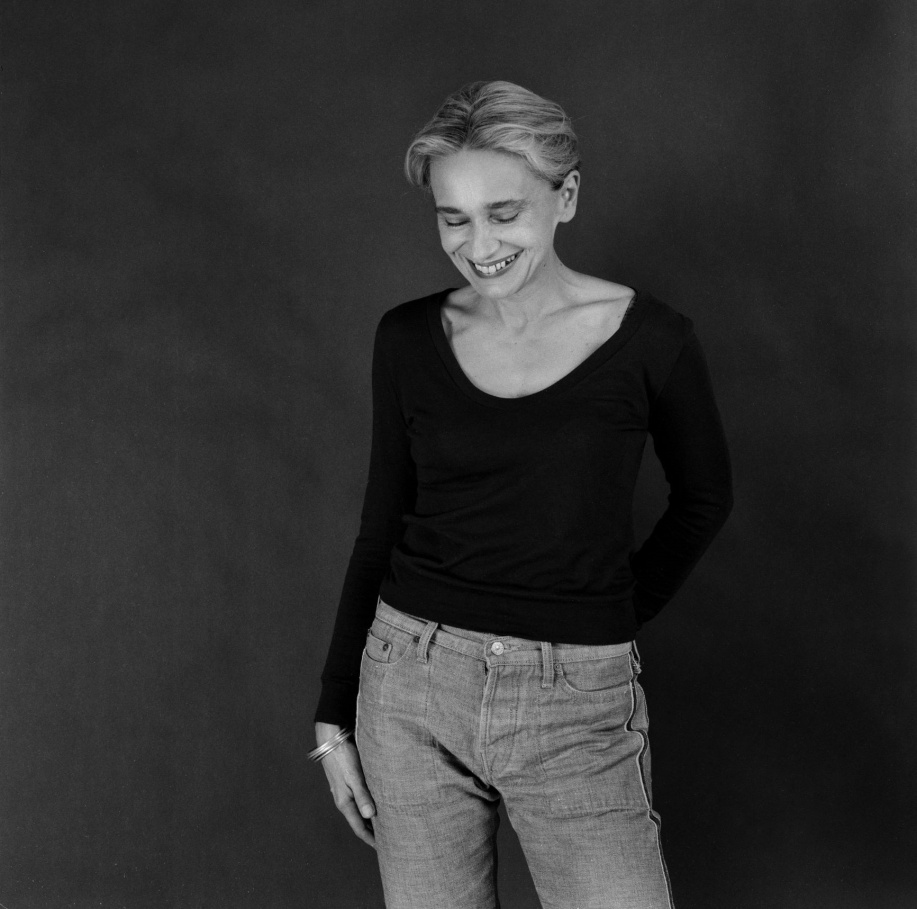
Photo by Ferdy Carabott
Named after a Balkan folk song, Too Early for Sorrow too Late for Happiness this video essay is a meditation on home and place, that documents the intensity of a moment when personal and social history collide. By exploding landscapes and music her journey suggests that for exiles movement and travel can become an experience and a strategy for survival.
- Production, Direction, Pphotography, Narration
- Breda Beban
- Cast
- Dragana Žarevac, Miroljub Mima Marjanović, Srđan Šaper
- Filmed on location in London, Belgrade, Novi Sad
- Duration
- 45 min
- Format DV-cam, colour
Little Films to Cry To
2002-2003
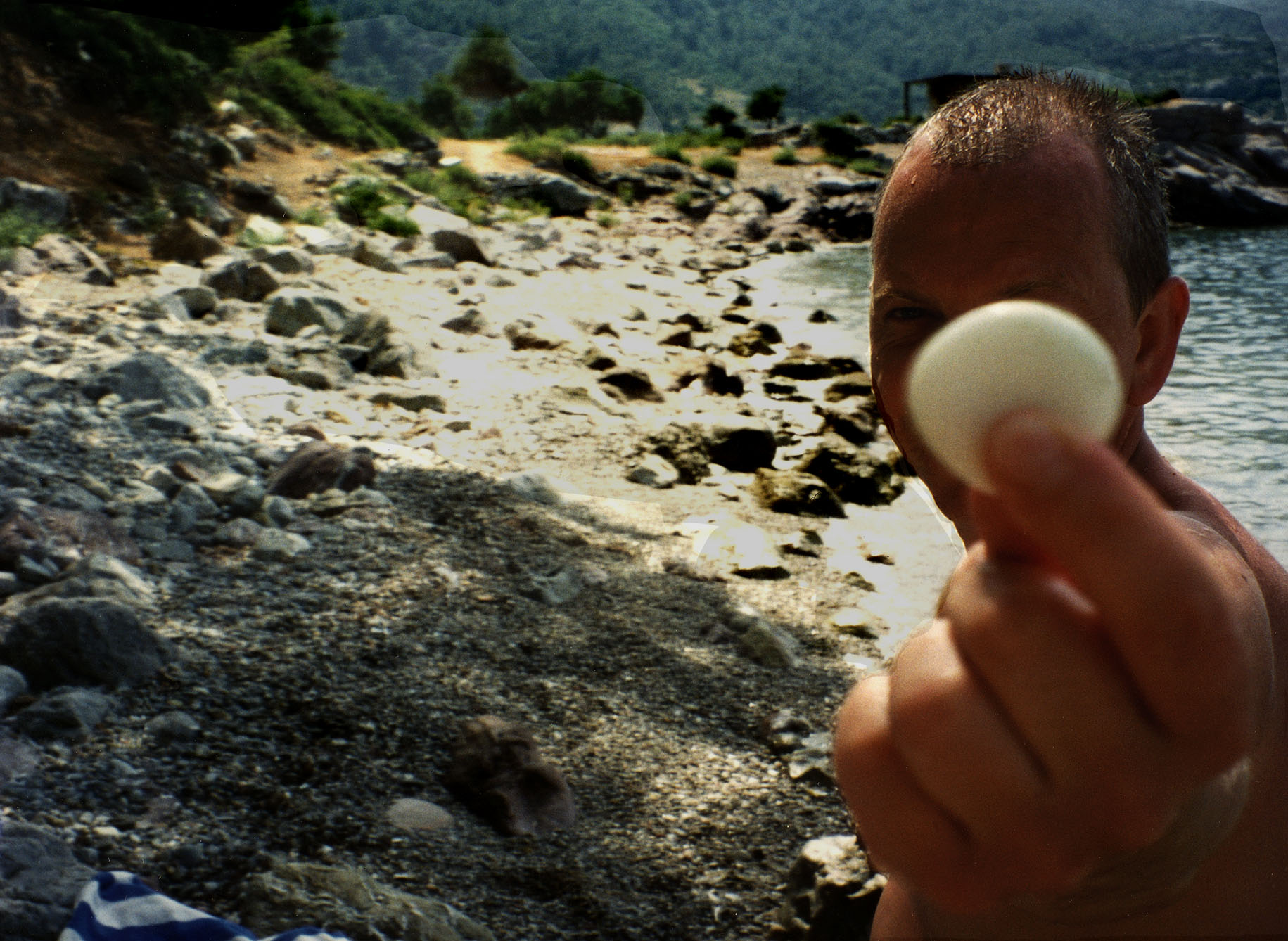
In terms of genre Little Films to Cry to are home movies, in terms of subject matter they are invested with tragic events and sadness, in terms of production they are happy accidents. In all instances, the name of the film is taken from the name of the song that features in the film. All films are produced and filmed by Breda Beban.
Imagination is Funny, 2002
- super 8 mm & DV cam, 5mins 20sec
- with Breda Beban
- super 8 mm footage filmed by Hrvoje Horvatić (1996)
- song by John Burke e Jimmy van Heusen, vocals Chet Baker
- locations: Paris & Zagreb
Together Again, 2003
- super 8 mm film, 4mins
- with Hrvoje Horvatić
- song by Buck Owens, vocals Emmylou Harris
- filming location: London
Angel, 2003
- mini DV cam, 12mins 30sec
- with Cressida Lewis, Catherine Dempsey and Sam Blunden
- song by Caroline Franklin e Sonny Sounders, vocals Aretha Franklin
- location: London
One Day in a Far-off Place Somewhere, 2003
- mini DV cam, 4mins
- composer Angelo Vlatković, song written by Slobodan Marković, 1961
- vocals: Lola Novaković
- location: London
Monastic Calling, 2003
- mini DV cam, 5 mins 30 sec
- with Željko Stojanović, Dubravka Cherubini, Breda Beban
- song written and performed by John Sturman
- locations: Zagreb & Adriatic coast, Croatia
Love Itself, 2003
- mini DV cam, 6 mins 30 sec
- song written and performed by Leonard Cohen
- location: Island of Ugljan, Adriatic coast, Croatia
Beautiful Exile
2003; five screen film for gallery staging
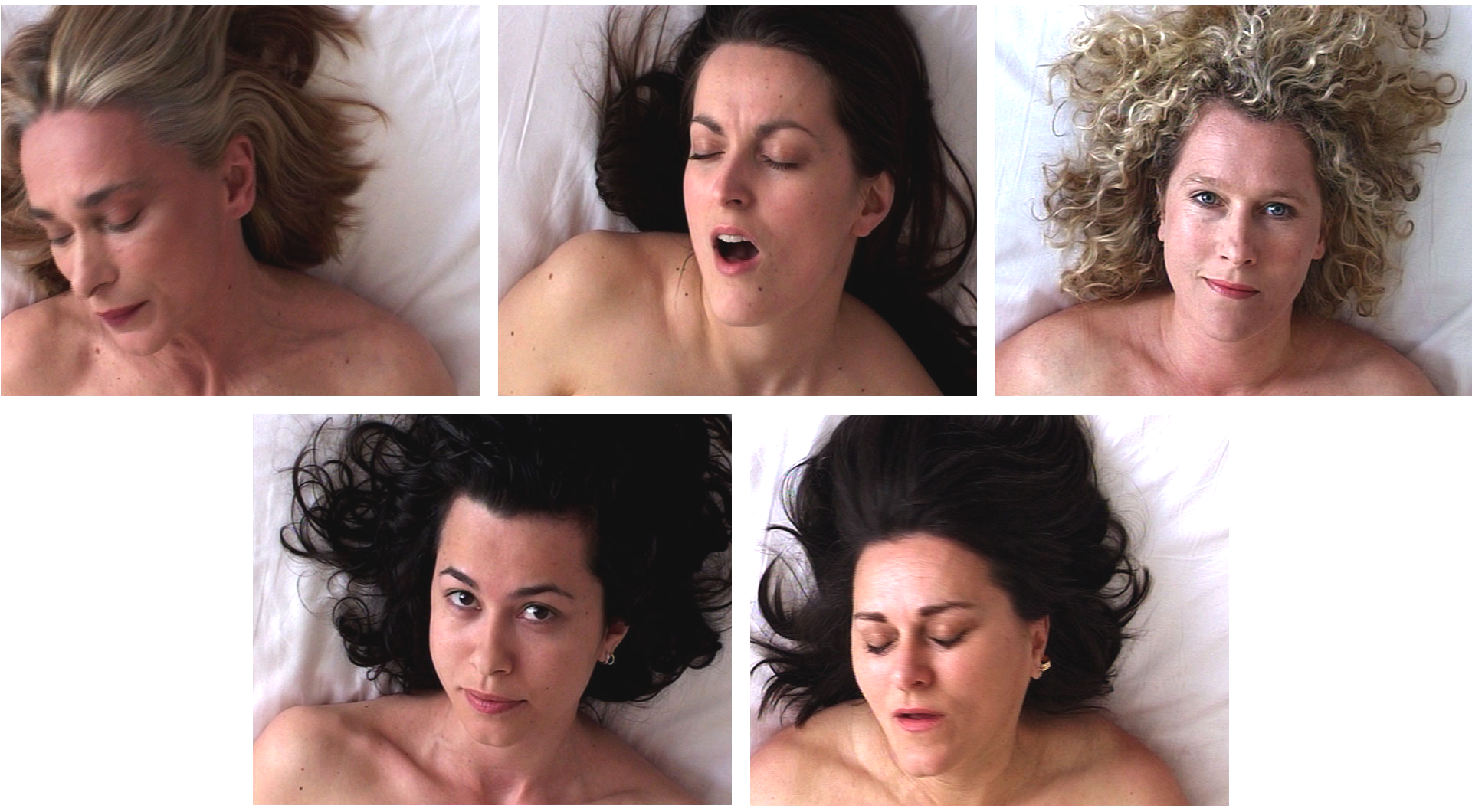
‘What sleeps in a rock, dreams in a plant, lives in an animal, becomes conscious in a human being’ 14th century, anonymous
Beautiful Exile comprises of five portraits of women before, during and after orgasm. Filmed as silent single takes, the portraits are staged as projected on five large screens.
Beautiful Exile was triggered by the word arrivals, which is Breda Beban's favourite word, Rainer Maria Rilke's Duino Elegies and Robert Bresson who said: ”The human face is the most beautiful landscape”.
The portraits were filmed by cinematographer Robby Müller in Duino, Italy. Müller was best known for his work with a number of influential directors including Jim Jarmusch, Lars von Trier and Wim Wenders.
- Production & Direction
- Breda Beban
- Photography
- Robby Muller
- Cast
- Breda Beban, Dubravka Cherubini, Cressida Lewis, Kati Lopez, Irena Rodić Mičijević
- Filmed on location in Duino, Italy
- Duration of individual segments looped varies from 6 to 15 minutes
- Minimum screen size
- 300 x 400cm each screen
- Commissioned by
- Peer
- Funding
- Peer, Bloomberg and Henry Moore Foundation
- Editions
- 3
I Can’t Make You Love Me
2003; two screen film for gallery staging
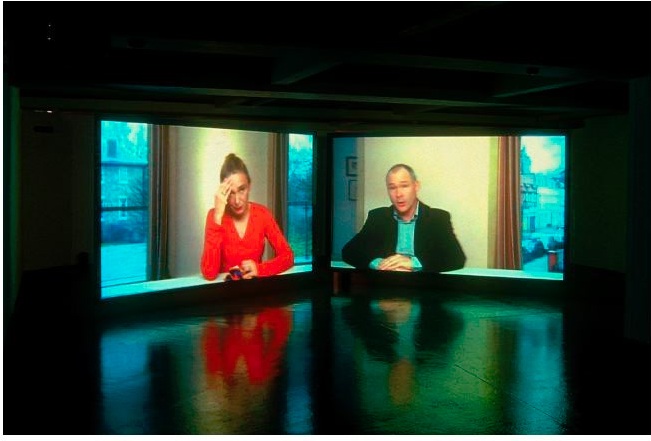
I Can’t Make You Love Me is an homage to Gertrude, a film by Carl Theodore Dreyer about a woman who refuses to speak any other language except for the language of love.
The film was predesigned for one continuous shot with two film cameras mounted back to back on a dolly. When staged in a gallery, the film takes the form of a dialogue between two ex-lovers, each of which is projected on a separate screen. In this way, two characters who are sharing the same cinematic space and time are also at once each inhabiting their own frame. Seated on either side of the same table, these two figures cut off at midriff, move away from each other and then into each other and then away from each other again. They are like two moving icons engaging with one another yet unable to exchange or share anything. The movement of the cameras cuts with cruel regularity through the scene. It creates a cinematic point of view which can be thought of as that ‘of the wind on the table’. With this movement the viewer is drawn inside the encounter and a space is opened up for the possibility to share in this spectacle of non-sharing.
- Shot on location in London, England
- Colour
- Screens
- custom made front/rear projection screens with aluminium frame
- Size 371cm W x 215cm H each screen
- Two 8-minute segments looped on two screens
- Editions
- 3
Stories I Tell Myself
2003; Movie for gallery staging
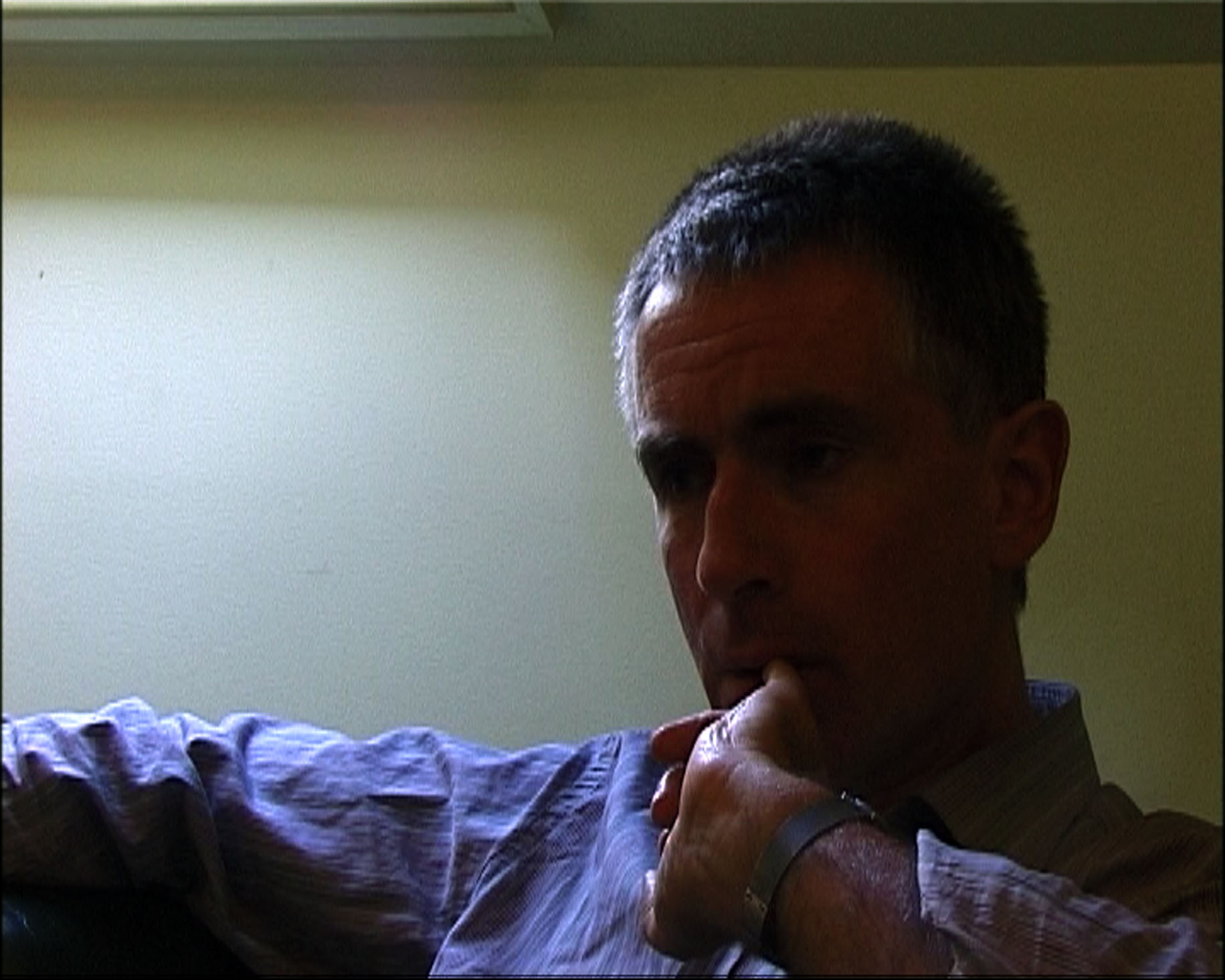
Stories I Tell Myself is a recording of two genuine sessions involving the psychoanalyst Chris Oakley and Breda Beban. The subject of the first sessions is money, the subject of the second is love. In both sessions the artist demonstrates a substantial degree of what in psychoanalytical terms is referred to as ‘the nonsense of the patient’.
The two sessions were selected from numerous sessions, all documented in the same cinematic style. The visual component consists exclusively of a continuous, static, close-up shot of the psychoanalyst who is listening, while the sound element documents the event in its entirety. It is the artist/patient who does most of the talking. While listening to Beban’s stories we are looking at the psychoanalyst who is also listening. In this way, listening collapses into an observation of listening, the language meets its other in the silent openness of the visual image.
- Production and Photography
- Breda Beban
- Editing
- Steve Sprung
- Cast
- Chris Oakley and Breda Beban
- Filmed on location in London
- Colour
- 90-mins segment looped
- Commissioned by
- Film & Video Umbrella
- Funding
- Arts Council of England
Walk of Three Chairs
2003; film for gallery staging
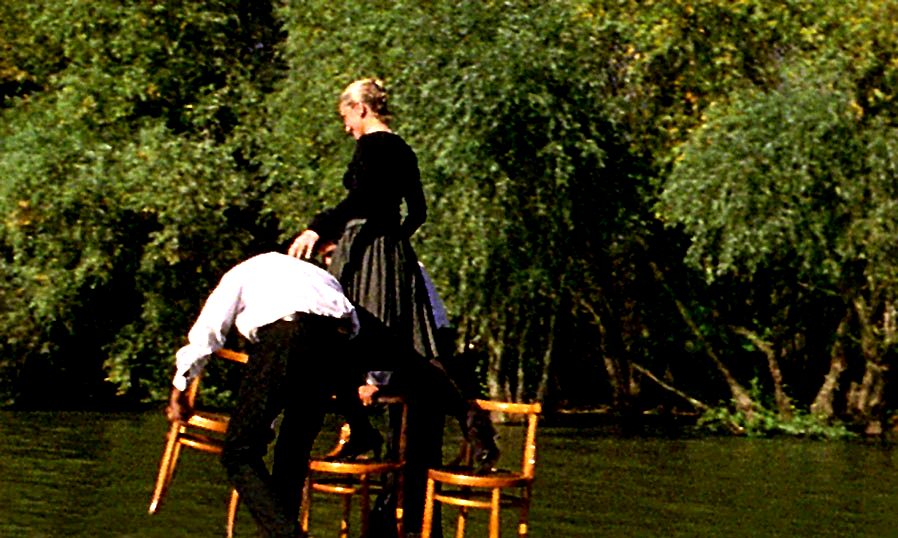
Walk of Three Chairs shows Breda Beban floating on a raft between two banks of the Danube in Belgrade, believed by some to be the point at which the Balkans end and Europe begins. One bank reveals an industrial landscape whilst the other is populated by trees and wooden dachas. The movie takes its title from a traditional Balkan pagan ritual, one that the artist recalls her grandfather performing after winning at gambling. The precarious yet celebratory act performed by Beban against the shifting backdrop, is for her an expression of ‘a complex kind of joy, joy informed by sadness’. This idea of bitter sweet is encapsulated in the love song Beban attempts to sing as she travels: Who Doesn’t Know How to Suffer Doesn’t Know How to Love.
- Production & Direction
- Breda Beban
- Photography
- Robby Muller
- Editing
- Steve Sprung
- Sound
- Dejan Pejović
- Music
- traditional Balkan song ‘Who Doesn’t Know How To Suffer Doesn’t Know How to Love’
- Cast
- ‘Jova’ band, Breda Beban
- Filmed on location in Belgrade
- Colour
- Recommended projection size 400 x 225 cm minimum
- 10-mins segment looped
- Commissioned by
- Film & Video Umbrella
- Funding
- The Arts Council of England
- Editions
- 3
How to Change Your Life in a Day
2004; film for gallery staging
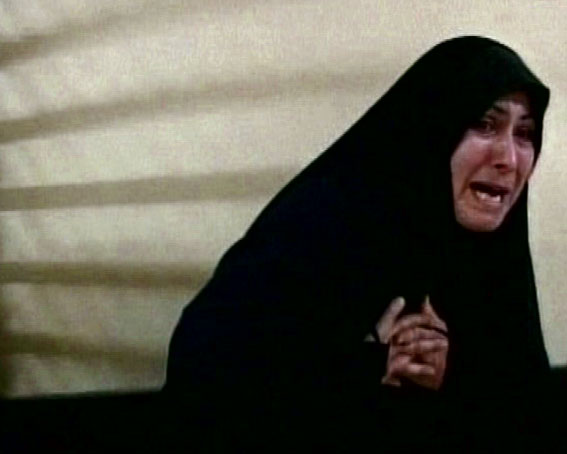
Based on Breda Beban’s personal experience of war, How to Change Your Life in a Day features a soundtrack from Paul McKenna’s mind-programming CD How to Change Your Life in Seven Days.
How to Change Your Life in a Day is set to the sound of a hypnotic voice that induces a trance like state in the viewer. The images show the domestic setting of a covered window, overlooking a residential area in London, interjected by news-reel archive footage of grieving women. The window is covered by a blind which moves with the wind in tandem with the voice and appears to obey its instruction, occasionally revealing the outside view. The quest for the ideal self and perfect life is set alongside the outcomes of the grand narratives of contemporary world politics.
- Production, Photography & Direction
- Breda Beban
- Editing
- Steve Sprung
- Sound
- Mind-programming CD ‘Change Your Life in Seven days’ by Paul McKenna
- Sound id delivered through headphones for each viewer
- Archive footage and material filmed in London
- Colour
- Recommended projection size 400 x 300 cm minimum, a full-wall projection
- 10-minute segment looped
- Commissioned by
- Shot by the Sea Film Festival, Hastings, England
- Editions
- 3
The Most Beautiful Woman in Gucha
2006; two-screen film for gallery staging
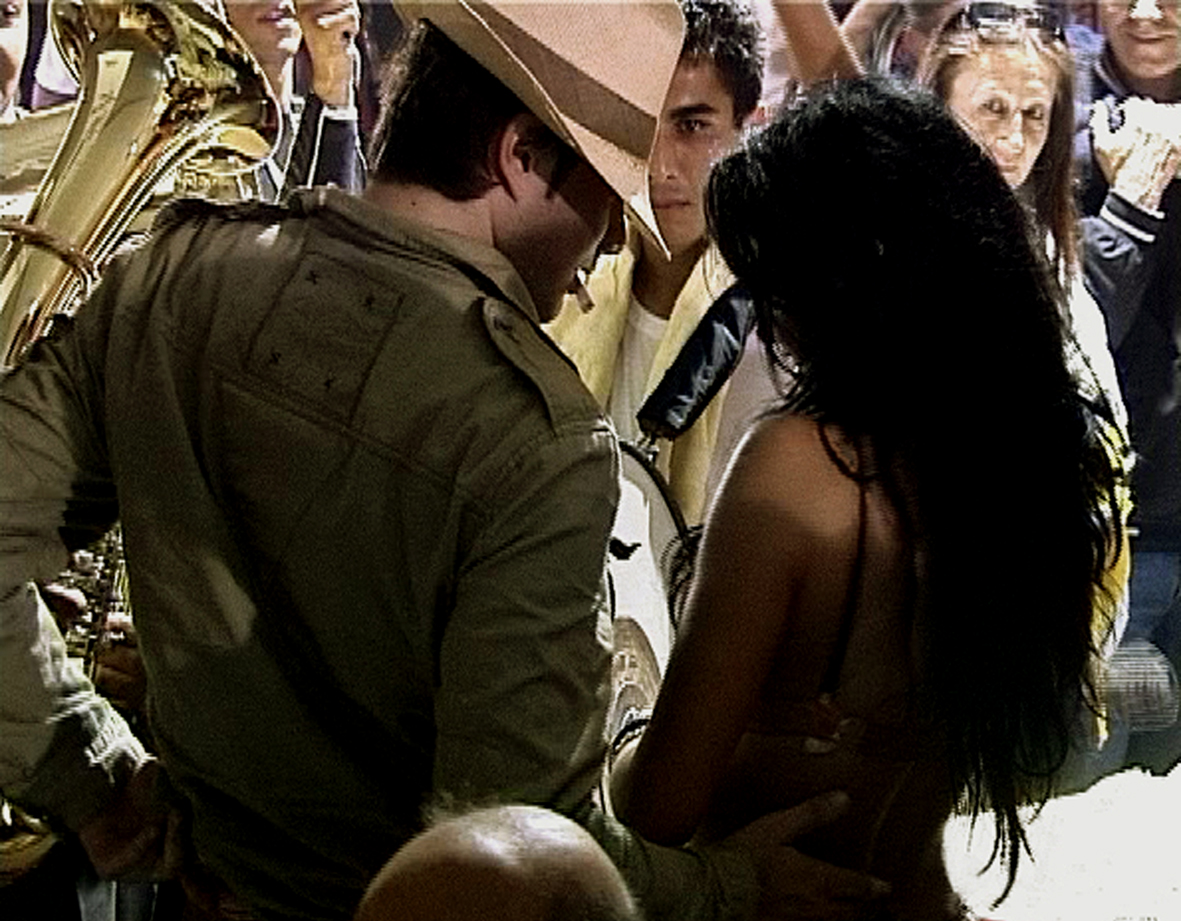
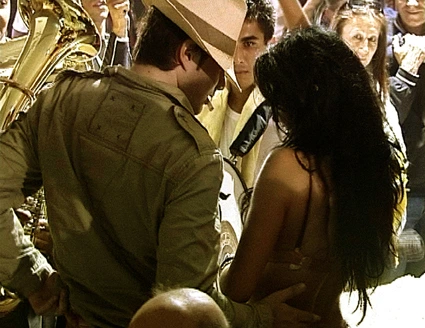
Staged on two screens, The Most Beautiful Woman in Gucha encapsulates a tension between the realness of a documentary situation and its fictionalisation by the camera and post-production strategies.
Filmed at the gathering of trumpet musicians in Serbia, the film captures a moment of magic instigated by a passionate encounter between a dancer, a young man and a group of Romany musicians.
- Production, Direction & Cinematography
- Breda Beban
- Editing
- Steve Sprung
- Sound script
- Breda Beban
- Filmed on location in Guča, Serbia
- Colour
- Projection size
- screen 1 minimum W 160 cm H 120 cm minimum; screen 2 minimum W 400 H 300 cm
- Duration
- screen 1 -19 min segment looped, screen 2 – 8.30 min segment looped
- Editions
- 3
My Funeral Song
2008 – 2010, five screen film for gallery staging

Whenever I want to move people without upsetting them, I use music – Breda Beban
My Funeral Song shows Beban’s close friends as they embark on internal journeys in anticipation of death. The project centres on the power of a well-loved song to compress an outlook on life into a telling moment that is at once emotional and thoughtful, melancholic and full of joy.
- Production, Direction & Photography
- Breda Beban
- Editing
- Steve Sprung
- Filmed on location in London, Buenos Aires
- Cast
- Eveline Schijf, Dušan Lazarević, Ana Čavić, Irena Micha, Pablo Casacuberta
- Colour
- 3 – 7 mins segment looped
- Five screen film for gallery staging
- Sound is delivered through headphones for each viewer
- Editions
- 3 + 2 a.p.